Kuji no kizuna
The Call of the WildThe harness is the central working apparatus of the sled-dog world: a system of straps and buckles that binds each animal to the sled and to the coordinated movement of the team. Its significance extends beyond equipment. Once placed on a dog, it changes posture, conduct, hierarchy, and even apparent purpose, making labor a physical discipline while also giving that labor a collective intensity the dogs themselves can experience as pride.
Appearance and First Use
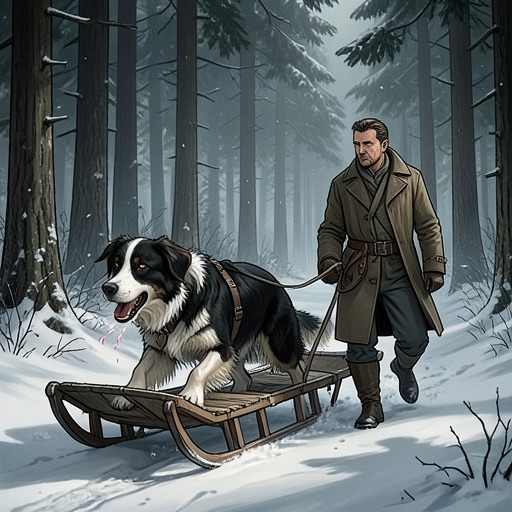
The harness first appears to Buck as an unfamiliar arrangement of straps and buckles, something resembling the equipment he had seen grooms place on horses. Francois fastens it upon him soon after Curly’s death and immediately sets him to hauling a sled to the forest and returning with firewood. The transition is humiliating to Buck’s former dignity: the aristocratic companion from the Judge’s estate has been made a draught animal. Yet he is too intelligent to rebel blindly. He accepts the new demand, works with determination, and begins learning the practical language of the traces.
The harness operates alongside other instruments of control. Francois demands instant obedience and enforces it with the whip; Dave corrects Buck’s mistakes by nipping his hindquarters; and Spitz, the experienced lead-dog, growls or throws his weight into the traces to pull Buck into proper alignment. Under this combined pressure, Buck learns to stop at “ho,” move forward at “mush,” swing wide around bends, and avoid the wheeler when the loaded sled rushes downhill behind him. The harness therefore functions not as a passive strap but as the material center of a training system in which commands, punishment, skilled instruction, and bodily adjustment converge.
Team Structure and Labor
The harness gives the team a visible and operational structure. Dave occupies the wheeler position; Buck is placed in front of him; Solleks follows Buck; and the remaining dogs stretch ahead in single file toward Spitz, who holds the lead position. Buck is deliberately positioned between Dave and Solleks so that their experience can educate him. Their teeth enforce the lessons more quickly than verbal instruction could, while Francois’s whip makes resistance costly. After one early tangle delays the start, Dave and Solleks administer a severe correction, and Buck thereafter keeps the traces clear. As his competence grows, the whip snaps less often, his companions stop nagging him, and Perrault examines his feet with care, recognizing that the new worker is becoming valuable.
The apparatus also transforms the dogs who already understand it. Once the nine-dog team is harnessed and begins moving toward the Yea Canyon, Dave and Solleks cease to seem passive or unconcerned. Harnessed, they become alert, active, and fiercely impatient with delay or confusion. The work of the traces appears to them as the supreme expression of their being, the activity for which they live and in which they take delight. Their change suggests that the harness is both an instrument imposed upon the animals and a framework through which their abilities, relationships, and ambitions become legible.
That framework creates a distinctive hierarchy. Spitz’s authority depends partly on his position as lead-dog and partly on his power to punish dogs who shirk or blunder in the traces. Buck’s growing mastery threatens that order. The pride associated with the harness is not merely obedience to a human driver; it is also the team’s internal code of competence, endurance, and rank. Buck comes to desire the lead because he has been seized by the pride of trace and trail, the same force that makes Dave excel as wheeler and Solleks pull with all his strength. The harness thus organizes both labor and political struggle within the team.
Hunger, Adaptation, and Exploitation
The harness places Buck inside a regime of relentless production. The team breaks camp in darkness, travels from the first gray of dawn, and makes camp after nightfall, sleeping in the snow after eating fish. Buck receives a pound and a half of sundried salmon each day, yet remains ravenous; lighter dogs receive only a pound and still maintain their condition because they were born to this life. The apparatus cannot be separated from the food economy that sustains it. It demands energy while the surrounding conditions make food scarce, forcing the dogs to compete over every ration.
Under that pressure, Buck loses the fastidiousness of his former life. Other dogs steal unfinished portions from him, so he learns to eat quickly and eventually to steal. Watching Pike secretly take bacon when Perrault’s back is turned, Buck repeats the act the next day and escapes with the entire piece, while the awkward Dub is punished for the crime. The harness has helped create the circumstances in which such conduct becomes necessary: labor produces hunger, hunger rewards cunning, and survival requires the abandonment of the property rules associated with Buck’s southern home. Its straps therefore mark a wider transformation in which a civilized animal body is reorganized for the Northland’s violent economy.
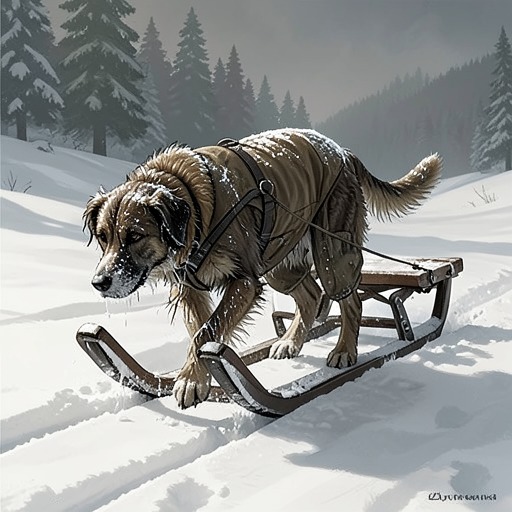
The burden becomes measurable in distance and flesh. During the mail journey, the dogs cover twelve hundred miles with only two days of rest, and the complete run from Dawson to Skaguay takes thirty days. In less than five months, the team has traveled twenty-five hundred miles, including eighteen hundred miles with only five days of rest. When they reach Skaguay, Buck’s weight has fallen from one hundred and forty pounds to one hundred and fifteen; the dogs are terribly footsore, their movements heavy, and their reserves exhausted. The harness remains taut only with difficulty, while downhill they can barely keep clear of the sled. It makes their labor possible, but it also records the slow drainage of their bodies.
Refusal, Death, and Exchange Value
The harness becomes most revealing when Dave is too sick to continue normally. At Cassiar Bar, he repeatedly falls in the traces, so the Scotch half-breed removes him and fastens Solleks to the sled in his place. Dave experiences the substitution as a dispossession. He attacks Solleks, tries to force himself between the dog and the sled, and ignores the whip while floundering through soft snow rather than following easily behind. His conduct is not simple disobedience; he is trying to reclaim the position that has defined his working life.
Dave eventually bites through both of Solleks’s traces and stands directly in front of the sled, where he belongs. The men interpret his pleading eyes and behavior through their knowledge of working dogs: a dog can break its heart when denied the labor that is killing it. They consider it merciful to let Dave die in the traces, where he can remain content. Harnessed again, he pulls proudly, though his inward injury repeatedly makes him cry out; he falls, is dragged, and is once run over by the sled, leaving him limping. After reaching camp, he is too weak to travel, but at morning harness-up he still crawls toward the other dogs and strains toward the harnesses until his strength fails. A revolver shot behind the river timber confirms what Buck and the other dogs understand: the harness has been Dave’s vocation, his dignity, and finally the setting of his death.
The same object is also treated as merchandise. When the exhausted team reaches Skaguay, official orders require fresh Hudson Bay dogs to replace those considered worthless for the trail. The worn animals are sold because dogs count for little against dollars, and Hal and Charles buy Buck and his companions, harness and all, for a negligible price. The phrase joins animal and equipment in a single transaction, exposing how the working dog is reduced to a replaceable component of transport. The harness carries both the evidence of months of service and the logic by which that service is assigned a market value.
Love, Power, and Later Freedom
In the contest over Buck’s ability to pull one thousand pounds, the harness becomes the stage on which bodily labor is converted into public value. Matthewson wagers one thousand dollars that Buck cannot break out and haul a sled loaded with twenty fifty-pound sacks of flour for a hundred yards. Buck is placed in the sled with his own harness, and the crowd inspects him as a magnificent working animal: one hundred and fifty pounds without superfluous flesh, a shining coat, and muscles hard as iron. His value is simultaneously physical, financial, and emotional, since the test is undertaken because Buck wants to accomplish something great for John Thornton.
Before the attempt, John Thornton kneels beside Buck, holds his head, and whispers, “As you love me, Buck. As you love me,” to which Buck responds with suppressed eagerness. Buck then takes Thornton’s mittened hand between his jaws, pressing and slowly releasing it, an answer expressed through attachment rather than speech. The harness is present at the moment when a commercial test is transformed into an exchange between partners. It still holds Buck to the sled, but the immediate force that moves him is no longer simply the whip, hunger, or fear; it is his bond with John Thornton.
After John Thornton and his companions find a rich placer, the harness loses its constant centrality. The men work every day, earning thousands of dollars in dust and nuggets, while there is little for the dogs to do beyond occasional hauling of meat. Buck spends long hours by the fire, and his memories of an earlier, fearful world become more frequent. This reduced use does not erase the harness’s importance. It reveals that Buck’s identity has been formed through work so deeply that the absence of work opens space for memory and for the pull of the wild. The apparatus begins as a mark of captivity, becomes the medium of skill and pride, serves as the instrument of exhaustion and death, and finally recedes when Buck’s life moves beyond regular human-directed labor.